
Why Label Performance Matters Throughout the Supply Chain Journey
Every business invests significant time and resources into designing products, building brands, and optimizing operations. Yet one of the most important drivers of reliable supply chain execution is often overlooked: the performance of the label.
High-performing labels support product identification, pricing, barcode scanning, inventory visibility, and supply chain traceability long after products leave the facility.
Here’s a simple question worth considering: Can your business survive without labels?
The answer is almost certainly no.
Labels are often viewed as a finishing touch, something added at the end of production before products leave the facility. In reality, they are one of the last elements your business can control before a product enters the market, which makes performance critical. Once that product moves into the supply chain, the label must continue carrying the information needed to identify, route, track, and deliver it successfully.
If the label fails to perform, the product journey can fail with it.
Why does label performance matter in the supply chain?
High-performing labels help products remain identifiable, scannable and traceable throughout the supply chain. Reliable labels support barcode scanning, inventory visibility, routing, fulfillment and product identification while helping reduce disruptions caused by unreadable, damaged or detached labels.
Why Does Label Performance Matter in the Supply Chain?
Before products leave your facility, every detail is carefully managed. Manufacturing processes are monitored, packaging is inspected, and quality standards are verified. Then the product is labeled.
From that point forward, your business depends on the label to perform reliably and communicate accurate information throughout every stage of the supply chain.
Whether products move through distribution centers, warehouses, retail and grocery, or directly the consumers, the label serves as the connection between your product and everyone who handles it.
It quietly performs one of the most important jobs in your operation.
What Happens When Supply Chain Labels Fail?
A label’s first responsibility is not simply displaying information; it is protecting that information through consistent performance throughout the product’s journey. More than identifying a product, a high-performing label helps guide its entire journey through the supply chain. It tells teams where the product belongs, what it is, whether it can be scanned, and if it is ready for sale.
Barcode readability is critical to supply chain performance. GS1’s Barcode Verification Process Implementation Guideline outlines industry best practices for maintaining barcode quality and scan reliability across the supply chain. (GS1 Barcode Verification Process Implementation Guideline) https://ref.gs1.org/guidelines/barcode-verification/
Real-world supply chains depend on reliable barcode scanning and product identification to keep products moving. When label performance fails and barcodes become unreadable, products may require manual verification, relabeling, or additional handling before moving forward. These disruptions can impact inventory visibility, supply chain traceability, fulfillment speed, and overall operational efficiency.
In many ways, labels act as silent navigators.
Every scan, every shipment, every handoff, and every customer interaction depend on reliable label performance. When a label can no longer perform, the information riding on it does not matter. Even accurate barcodes, expiration dates, lot numbers and pricing information offer little value if the label cannot be read or stay attached to the product.
What Makes a High-Performance Supply Chain Label?
The information printed on a label is important. But information alone isn’t enough. For operations, label performance is about more than adhesion. It is about maintaining the integrity of critical product information throughout handling, storage, transportation, and fulfillment.
Whether exposed to environmental conditions, transportation, or frequent handling, a label must remain attached, legible, and durable. Consistent performance helps ensure critical information remains traceable, and operations continue running smoothly.
How Labels Support Traceability, Inventory Management, and Fulfillment
Labels influence far more than logistics.
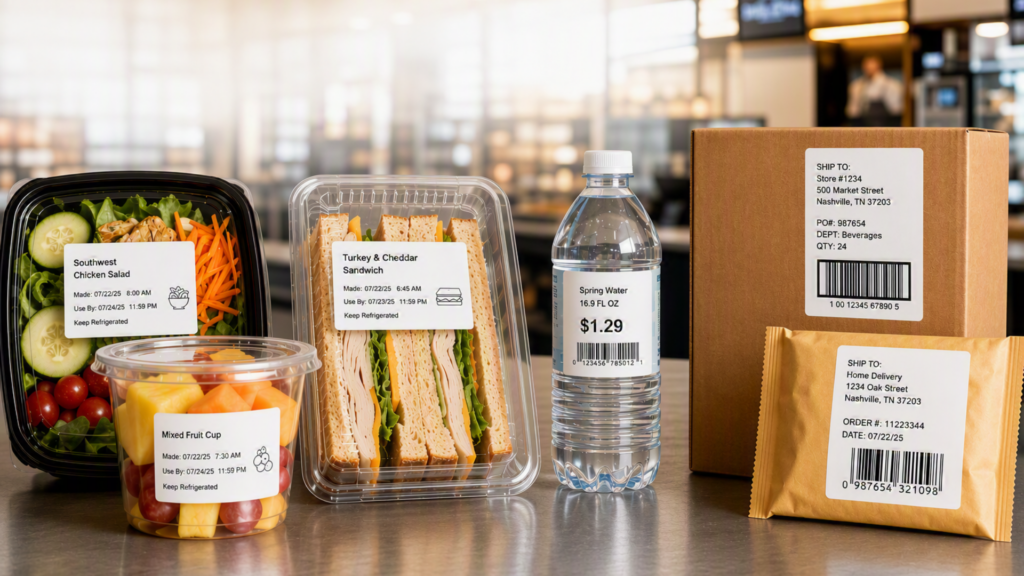
Labels support supply chain operations by connecting products with the information needed for food safety, pricing, inventory management, traceability, shipping and fulfillment.
Food Safety and Freshness
Labels communicate expiration dates, preparation times, allergens, ingredients, and handling instructions that help businesses maintain food quality and safety.
Pricing and Merchandising
Retail labels ensure customers receive accurate shelf-marketing and pricing information while helping associates replenish inventory and manage promotions efficiently.
Inventory Visibility
Labels provide the identification needed to locate, count, and manage inventoried products throughout warehouses and distribution networks.
Shipping and Fulfillment
Shipping labels connect products with customers by enabling accurate routing and delivery throughout the supply chain.
Regardless of the industry, high-performing labels help transform products into identifiable, traceable, and deliverable assets.
Why Label Performance Matters
• Keeps product information readable and accessible
• Supports reliable barcode scanning
• Improves inventory visibility and traceability
• Helps products move accurately through fulfillment
• Supports food safety, pricing and product identification
• Reduces disruptions caused by damaged or unreadable labels
How Do Labels Keep Products Moving Through the Supply Chain?
Labels rarely receive attention when everything goes right. Customers don’t notice them. Employees often take them for granted.
But behind every successful delivery, every accurate order, and every efficient workflow is a label quietly doing its job. It carries the information your business depends on and helps products move confidently through complex supply chains, so customers receive the right product at the right place and time.
What makes a supply chain label high-performing?
A high-performing label should remain attached, legible and scannable throughout its intended lifecycle. Label materials, adhesives, print quality, barcode readability, environmental exposure, application surface and handling conditions can all influence performance.
How Do You Choose the Right Label for Supply Chain Performance?
Labels may be one of the smallest components of a product, but they carry enormous responsibility. Selecting the right labeling solution is not simply about printing information; it is about prioritizing performance so that information remains connected to your product from the moment it leaves your facility until it reaches its final destination. Investing in high-performance labeling solutions helps businesses improve product traceability, inventory visibility, barcode scanning accuracy, and operational efficiency across the supply chain.
As a trusted leader in the label industry, Iconex understands that performance is what keeps products moving and operations running efficiently.
Backed by more than a century of printing expertise, our lined label solutions are engineered and lab-tested to perform in demanding real-world environments where product identification, traceability, and operational efficiency matter most.
After all, information is only valuable when the label performs.
Frequently Asked Questions
What is label performance?
Label performance is the ability of a label to remain attached, legible and scannable throughout its intended use, helping critical product information remain accessible.
Why is barcode readability important in the supply chain?
Reliable barcode readability supports product identification, inventory management, routing and fulfillment. Unreadable barcodes can require additional handling, verification or relabeling.
How do labels improve supply chain traceability?
Labels connect products with identifying information such as barcodes, lot numbers, dates and other data used to track products as they move through the supply chain.
What can cause a label to fail?
Adhesion, handling, storage conditions, transportation, environmental exposure, print quality and application surfaces can all affect how well a label performs.
How do you choose the right label for a supply chain application?
Consider the application surface, environment, required lifespan, handling conditions, barcode and print requirements, adhesive performance and the operational needs of the application.