
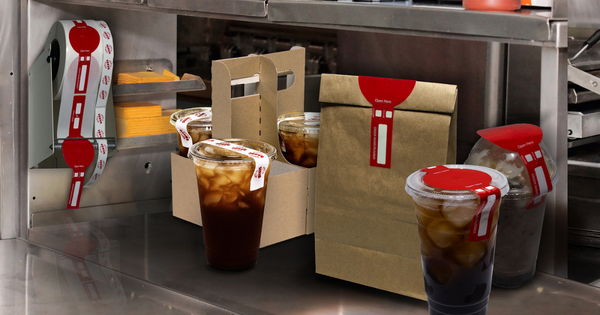
For quick-service and limited-service restaurants, off-premise channels — drive-thru, takeout, curbside, and delivery — have become core business drivers.
The shift has prioritized labeling for these applications. Influencing a brand’s reputation, labels correctly tie items to an order, communicate instructions and timing, and travel with the food wherever it goes. If labels are hard to read, peel off, or fall off during fulfillment, every part of the process can be affected — from order accuracy to labor efficiency and guest satisfaction.
Lined labels support critical QSR and LSR operations by helping restaurants manage food freshness, date coding, inventory rotation, order identification and tamper-evident security. For drive-thru, takeout, curbside and delivery orders, the right labeling solution can help improve food safety, order accuracy, operational efficiency and the guest experience.
How Food Freshness Labels Support QSR Food Safety
Labeling is critical for managing food safety compliance and waste control. Food freshness labels can be used on reusable kitchenware, fresh ingredient and inventory containers, and pre-packaged and made-to-order packaging to communicate:
- Prep date and time
- Hold time and discard time
- Food station or storage location
- Responsible party identification
Doing so contributes to successful critical-to-quality criteria (which determine product acceptance), rotation processes (using older stock first), and shelf-life indicators (the time period during which food stays fresh).
How Date Coding Labels Improve Food Rotation and Reduce Waste
DT Extreme labels for date coding and food rotation applications are designed to clearly indicate critical-to-quality information, including time, date and expiration.
Consistent label use supports Hazard Analysis Critical Control Point (HACCP) programs, internal audits and staff coaching. It also helps minimize expired (keeping food longer than necessary, a safety risk) and premature discarding (disposing of food before it’s necessary).
Clear date code labels support food safety, inventory control and customer experience — ensuring that the right product is used within its safe hold time and making it easy to identify, rotate and pull expired items. This reduces both risk and waste.
Additionally, barcoded or scannable item IDs can feed into inventory and analytics systems, showing which products and ingredients move fastest and at what times of day, which informs ordering and labor planning.
How Tamper-Evident Labels Protect Takeout and Delivery Orders
For food delivery processes, tamper-evident labels serve both practical and brand-affirming roles. Importantly, they help maintain order integrity from the restaurant to the guest’s door. Lined labels:
- Provide best-in-class tamper-evident designs
- Enable consistent, quick hand-apply under time pressure
- Integrate tamper messaging and branding on a single printed piece
Tamper-evident labels are used to seal bags and containers to indicate items weren’t opened or altered while in transit. Combining tamper-evident labels with item and bag labels that list contents and customer name offers guests even more peace of mind.
For restaurants working with multiple delivery platforms, a consistent labeling and sealing system also reinforces a brand’s standards, regardless of what company or driver delivers the food.
Click here for more information on Iconex lined label solutions and applications for QSR and LSR off-premise channels.
Frequently Asked Questions
1. How are lined labels used in QSR and LSR restaurants?
Lined labels support food freshness, date coding, inventory rotation, item identification, order fulfillment and tamper-evident security across restaurant operations.
2. How do food freshness labels support restaurant food safety?
Food freshness labels can communicate preparation times, hold times, discard times, storage information and other critical details that help employees properly manage food throughout its usable life.
3. How do date coding labels help QSR operations?
Date coding labels make time, date and expiration information easy to identify, helping restaurant teams manage food rotation, reduce unnecessary waste and support consistent food safety procedures.
4. Why are tamper-evident labels important for restaurant delivery?
Tamper-evident labels help seal bags and containers so guests can identify whether an order may have been opened or altered between the restaurant and delivery.
5. Can restaurant labels support inventory management?
Yes. Barcoded or scannable item identification can connect products and ingredients with inventory and analytics systems, helping restaurants better understand product usage and support ordering and labor planning.