
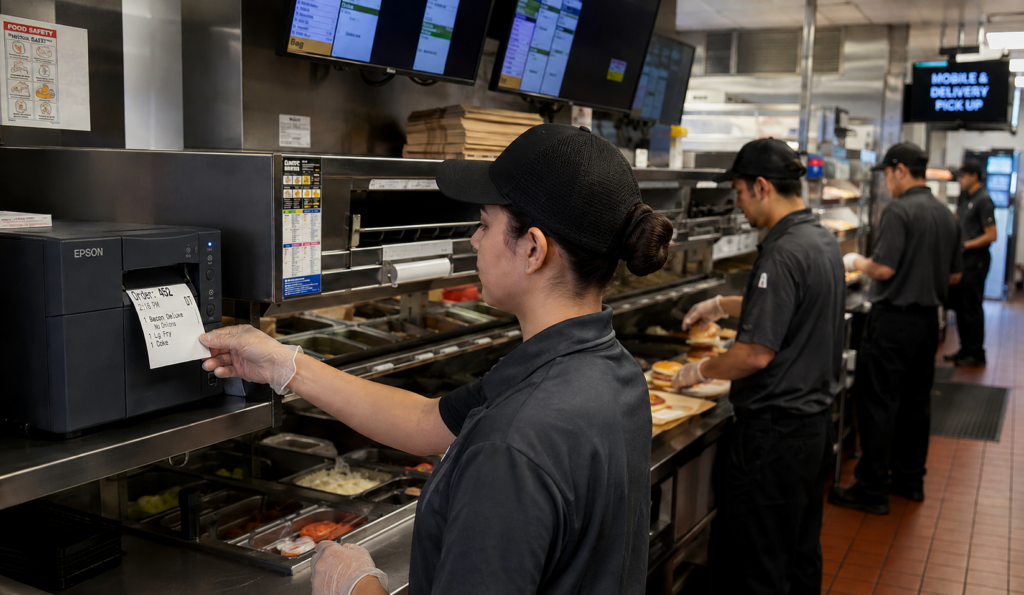
According to the National Restaurant Association, nearly 75% of all restaurant traffic now happens off-premises. Off-premise ordering has redefined the modern quick-service and limited-service restaurant experience — and as it continues to grow, so does linerless labeling within this ecosystem.
Linerless labels have become the essential infrastructure for restaurant performance — supporting accuracy, efficiency and guest confidence. They offer distinct roles across three primary areas:
- Back-of-house (BOH) kitchen operations
- Item identification order management
- Final delivery integration via point-of-sale (POS) handoff
BOH Orders, Workflow and Waste
Item and order identification processes are crucial to ensuring consistent execution throughout the order fulfillment lifecycle, improving visibility, internal communication, service channel coordination across daily workflows, and sustainable waste reduction.
Integrating linerless labels into these processes clearly ties every item to a specific order. Through precision and automation, linerless labels enhance critical POS and kitchen systems applications:
- Item labels at make-lines
Each order generates item-level labels that include the item name, customizations and order identifier. As sandwiches, bowls, drinks and sides are prepared, labels are applied directly onto each packaging substrate. This helps station staff keep track of complex builds and modifications, enabling fast verification during fulfillment.
- Integrated receipt/label media
Linerless media combine receipt paper and a linerless pressure-sensitive label into a single roll. The integration serves as both the guest receipt and fulfillment label. Operationally, this reduces the number of media SKUs, simplifies training and standardizes consistent process workflows across all restaurant operations.
- Label waste management
Because linerless labels do not require a liner, eliminating this standard component can significantly reduce landfill waste, remove slipping hazards in workspaces, and provide up to 40% more labels per roll — depending on label length. This leads to fewer changeovers and improved efficiency.
Item Identification
From order entry to make-lines and final order fulfillment, off-premise touchpoints call for food item identification. Linerless labels are easily applied to bags, cups, wraps and clamshells — connecting individual items to specific guests or deliveries.
In QSR and fast-casual environments, item-level identifiers are ideal for kitchen make-lines. By helping build and assemble the right items and quantities, service teams can match each order with the correct package or tray. Consistently using standardized labeling like this reduces manual errors and reliance on memory, lowering the risk of order mishaps.
With benefits like improving speed of service, streamlining operations, enhancing communication and supporting sustainability goals, linerless labels are quickly emerging as the preferred option for foodservice item identification in high-volume kitchens.
Staging Accuracy
Poor order staging processes can lead to missing items, wrong beverages or order delays, which directly impacts brand reputation, customer satisfaction and revenue. Linerless labels improve staging accuracy by giving every beverage and package substrate a clear, consistent identifier that ties individual items to a specific ticket and guest for a final order that is complete, correct and ready at handoff.
Linerless labels printed from a kitchen display system (KDS), for example, list the order number, guest name, modifiers and routing points. This helps service line and kitchen teams confirm that all components are present before an order leaves the line.
In drive-thru applications, research shows that leading QSR drive-thru programs are seeing 80% to 90% order accuracy — and that the brands that systematically improve accuracy experience measurable gains in overall satisfaction scores and repeat visits.
Additionally, when staff can quickly scan labels on orders at the window, counter or pickup area, it reduces their mental workload and replaces error-prone verbal checks, cutting down on mistakes during peak periods.
View our growing offering of Iconex linerless label solutions for QSR and LSR off-premise applications.